Welcome

🇫🇷  Bienvenue en France, expat américain 🇺🇸 

Feel silly or nervous when speaking French?

French grammar is super confusing?

Just want to communicate and FINALLY build connections?

Anxious about your big move—getting by with no or minimal French? 

If lack of French is impacting your well-being and you no longer recognize your positive, go-getter American self… 

FeelLingual has the American in France French language program for you!

Stop feeling silly. Start feeling competent in French—we’re gonna have fun, too!

Diverse people taking an escalator” by rawpixel.com

Business people working on a laptop” by rawpixel.com

Businessman talking on his phone” by rawpixel.com”

Get your fresh and FINAL start to French fluency with Ashley Josephine @ FeelLingual 

To get to the milestone of being Bilingual, first you’ve got to FeelLingual. This means you will:

✅ Feel sure of your language learning journey from Day 1

✅ Feel confident in your ability to speak French

Feel capable in what you can achieve in French now so you can use the positive momentum to continue building your skills

✅ Feel supported

Feel good about yourself while speaking French

This positive approach makes the difference between….

Attention ! You won’t find this approach in the French-run language programs 🚫

🇫🇷 FeelLingual en français for American Expats in Beginner’s French 🇺🇸 is the only A1-A2 French language program made for expats by an expat fluent in French.

Simple! You learn a new language faster when your teacher shares a similar background. A safe community builds the strongest foundation!

FeelLingual’s practical & energetic American-style classroom experience + French immersion will BOOST your confidence.

Fun online live lessons that motivate and spark your long-term memory through games, pop culture and an ingenious use of muscle memory through Augmentative and Alternative Communication (all the ways we communicate outside of speaking).

Combat confusion caused by challenging grammar rules thanks to a teaching style that makes grammar CONCRETE 💪

Get your message across in French so you can live your best life in France!  

FeelLingual gives you the language & support you need to find your voice in French and live to your fullest potential as a happy expat in France 😊

Use public transportation with ease. 

Get your shopping done.

Scout the best ingredients at your market.

Make appointments for self care.

Start to understand what you read & hear.

Order your café perfectly.

You don’t have to do this alone OR with a dull, uninspiring French teacher.

Join the program, get real support!

FeelLingual. Feel invincible.

Girlfriends shopping around the city” by rawpixel.com

FeelLingual is great for teens, too!

Program

Voilà, the FeelLingual Program

It’s bon bon bon !

Testimonials

IMG_7284
"Learning a second language is never an easy feat, but Ashley has a teaching style that made me WANT to learn French!"
Loryn Weer
"I have never had a teacher put as much effort into making the learning of a subject as immersive and exciting as she has... through music, current events, social activities, and even sign language! Now I interact with the French language daily at a fluent level, and I accredit that to having such a strong foundation in the beginning."
Aida Dodo
"Ashley takes the title of a teacher to new heights. I can honestly say, I would not be who I am without her being in my life. She is a great teacher, and a better role model."
Kamel Jones

Salut ! Je m'appelle Ashley Josephine...

After perfecting the craft of teaching French while in the US, becoming an award winning teacher, and moving permanently to Paris, she strives to help expats who feel lost in the language ditch their anxiety & self-doubt to reach their French language goals.

Course Outline

This is an overview of the units offered per level. FeelLingual offers 3 levels (sections) for Beginner’s Level French. Teaching is an evolving craft therefore units, objectives, resources, and topics may change. In addition, the focus is on quality, not quantity. With mastery as our goal, pacing and total units completed will differ based on your needs.

1ère Section: Débutant(e) en français

By the end of Unit 1, you will be able to:

Introduce yourself and others and greet someone over the phone, at a party, and at the office.

Share and exchange contact information.

By the end of Unit 2, you will be able to:

Invite others over. 

Talk about sports, music, and what you like (and don’t really like) to do. 

Give your opinion and agree and disagree with others. 

Ask other about their hobbies and opinions. 

By the end of Unit 3, you will be able to:

Ask how others are feeling and if they would like to go out. 

Give and tell the time. 

Talk about food, read a menu, place an order and pay the bill.

By the end of Unit 4, you will be able to:

Identify office and school supplies and their location in a room.

Plan your schedule and share your daily routine.

Talk about school and which subjects you like and dislike.  

By the end of Unit 5, you will be able to:

Point out and talk about family members and pets.

Describe physical and personality traits. 

Ask questions with who, what, where, when, why and how.

By the end of Unit 6, you will be able to:

Identify countries and nationalities and ask where someone is from.

Identify professions and ask about the work someone does.

Talk about the seasons and the weather.

By the end of Unit 7, you will be able to:

Express needs and wants.

Talk about and pick out clothing and invite friends on a shopping trip.

Ask the salesclerk for help and make a purchase. 

2ème Section: Un peu d'expérience en français

By the end of Unit 1, you will be able to: 

Write an invitation, give your address, and get to know others at a party.

Talk about the weather. 

Discuss events in the future and at what time they are happening. 

Identify things that belong to you and others and describe people and objects. 

By the end of Unit 2, you will be able to:

Talk about your job and other professions, and identify typical Parisian merchants and shops. 

Describe events in the past, and sequence event order.

Compare people and things. 

Talk about your and someone’s physical and personality traits. 

Make suggestions to the day’s itinerary during a visit in Paris with friends. 

Tell someone what to do.  

By the end of Unit 3, you will be able to:

Identify topography in France and talk about French cities and regions and their local specialties. 

Talk about and order a meal. 

Use and navigate public transportation and trains around France. 

Point something out and express astonishment, disbelief, or concern. 

Talk about events in the past tense. 

Expressing what you want to do, can do, and must do. 

By the end of Unit 4, you will be able to:

Share your day-to-day routine and what you did yesterday. 

Talk about how you get ready in the morning.

Tell someone what to do around the house and ask people to hurry.

Express emotions and preferences.


By the end of Unit 5, you will be able to:

Discuss sports, create an exercise routine and celebrate and commiserate with others. 

Talk about talents and abilities and congratulate someone on a job well done.

Ask if someone is free and accept and refuse an invitation. 

Give a gift and express appreciation. 

Pick something to watch on TV and talk about its genre. 


By the end of Unit 6, you will be able to:

Identify food products and talk about their prices

Create shopping and to-do lists

Meet with a banking consultant to create an account and start saving for future purchases

In Unit 7, you will be able to:

Plan and take an international vacation

Navigate the airport, border control and sky bar

3ème Section: Intermédiaire débutant(e) en français

We will read our first book written entirely in French. The books will be pedagogic in nature and are written for French as a second language learners.

Course Options,
Pricing and Discounts

Formule de base

Best Price
Rated 5 out of 5

This package includes:

    • One-hour live lesson with Ashley (on Google Meet)

A lot of 10 or 20 classes can save you 5% or 10%, respectively

50€ per class

Formule suprême

Most popular
Rated 5 out of 5

This package includes:

    • One-hour live lesson with Ashley (on Google Meet)

Et aussi

    • Pre-class video pour vous préparer pour la classe
    • After class activity pour appliquer la leçon chez vous
    • Oral and written evaluations pour mesurer votre progrès

A lot of 10 or 20 classes can save you 5% or 10%, respectively

55€ per class

Formule impériale

Best Deal
Rated 5 out of 5

This package includes:

    • One-hour live lesson with Ashley (on Google Meet)
    • Pre-class video pour vous préparer pour la classe
    • After class activity pour appliquer la leçon chez vous
    • Oral and written evaluations pour mesurer votre progrès

Et aussi

    • Help from Ashley on translation by phone, email or text pour vous faciliter dans vos interactions avec les personnes anglophones
    • Record your lessons with Ashley pour réviser vos leçons chez vous
    • Minor text corrections by Ashley  sur votre CV (résumé), e-mails professionnels, un discours (speech) préparé, etc.
    • Free resources and materials pour complémenter votre aventure en français

A lot of 10 or 20 classes can save you 5% or 10%, respectively

65€ per class

Group Classes
(4-5 students)

Coming très soon !

Coming soon! To join the waiting list, click the Reserve button below & check the box to show your interest.   

Base rate: 28 € / hour


The French Language and You:

The Immersive Classroom

The Best Way to Learn

Foreign language class ought to be conducted soley in the target language, with few exceptions. This is called immersive-style teaching. In the U.S., it is the recommended way for schools and institutions to teach a language. The problem is, this doesn’t happen very often.

The American foreign language classroom is guided by standards that maintain that 90% of class time be conducted in the target language. This means that during an hour-long course, at most one-tenth, or six minutes may be in English. This includes teacher and student speaking time. The aim is to create an immersive experience for students.

Nonetheless, and as many American students (and former students) know, few American classrooms are immersive.  Studies have shown variations between 10% and 100% of the use of target language in the classroom in the U.S. This is a wide discrepancy in the context, nature, and substance of foreign language education in spite of the standards.

Meanwhile in France, to date there are no immersion standards that foreign language teachers are expected to meet. This means that target language use is not a standardized feature in French institutions. 

The Dilemma 

There is a delicate balance between ‘new learning’ and student confidence (the more new information you have, the less confident you feel). Many teachers use this to defend their non-immersive classrooms. In other words, they teach the foreign language in the students’ first language (English) to avoid frustrating students and disrupting the positive learning environment. Ironically, the opposite happens. 

You don’t learn to cook a delicious meal by simply talking about food. This is not a positive learning environment to the student who becomes frustrated in the kitchen because he has not been properly taught.

Learners need a positive learning environment, a space where they have the support that they need in order to take risks and overcome challenges. This is perhaps even more crucial in foreign language. Take any another course for example, if you get the answer wrong, you can at least be sure that you pronounced it correctly. There is a lot of risk in a foreign language classroom. 

The Solution

Gesturing in the foreign language classroom helps mitigate risk because it promotes  communication through easy to grasp non-verbal cues, therefore creating a safe and positive learning environment.

Beginning language students want to express themselves, but they do not yet have the language ability to do so. This is where gesture comes in—it’s a common language. 

Gesture fulfills the role of the first language while at the same time supporting the second language. This means that dependance on the first language (English) can comfortably drop to zero. 

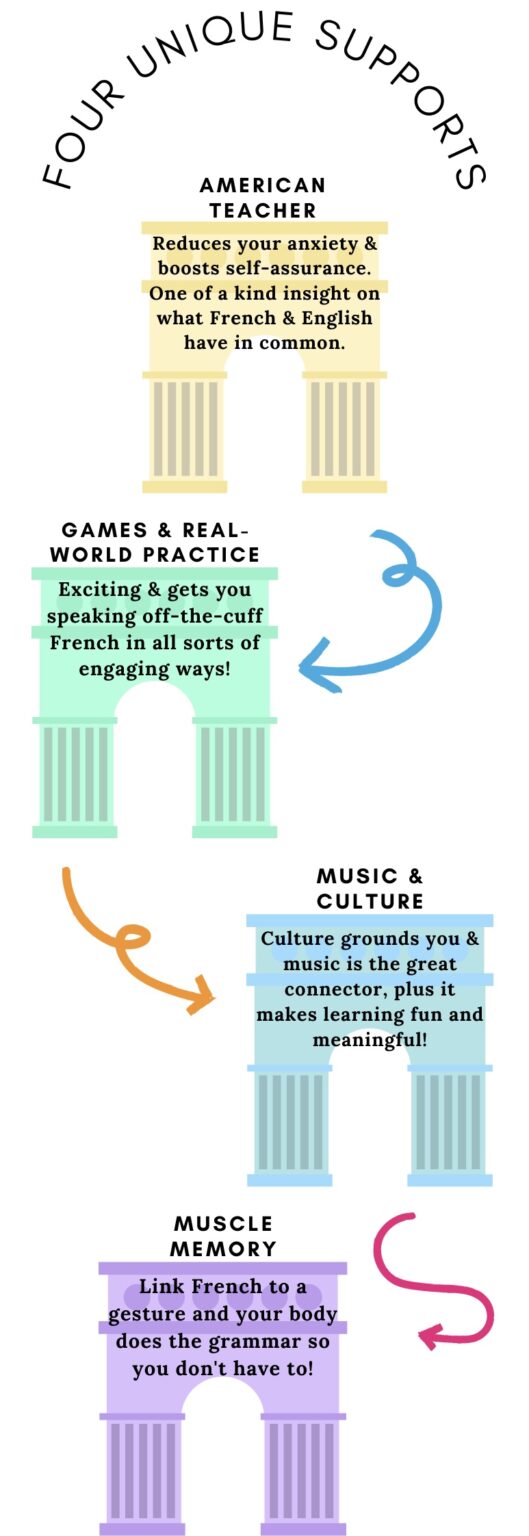
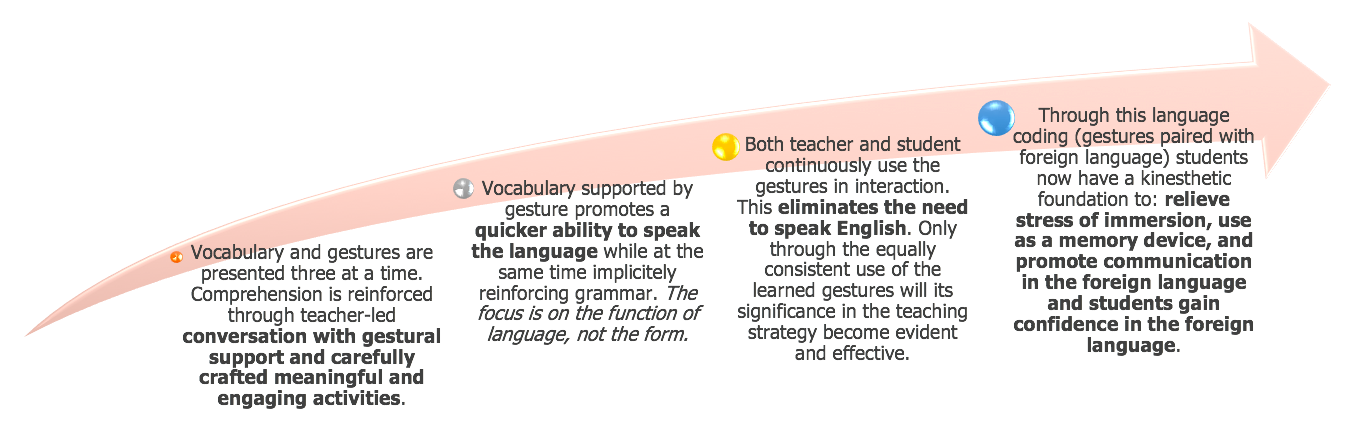
How does this promote a new language? By linking a certain word to a certain gesture you are anchoring that word to something physical. It’s muscle memory, and it’s why you can type your name without looking at the keyboard. This automaticity is why gesturing speeds up language acquisition.

That’s why it works. Next, take a look at the infographic below to see how it works in Ashley’s classroom.


About Ashley Josephine